
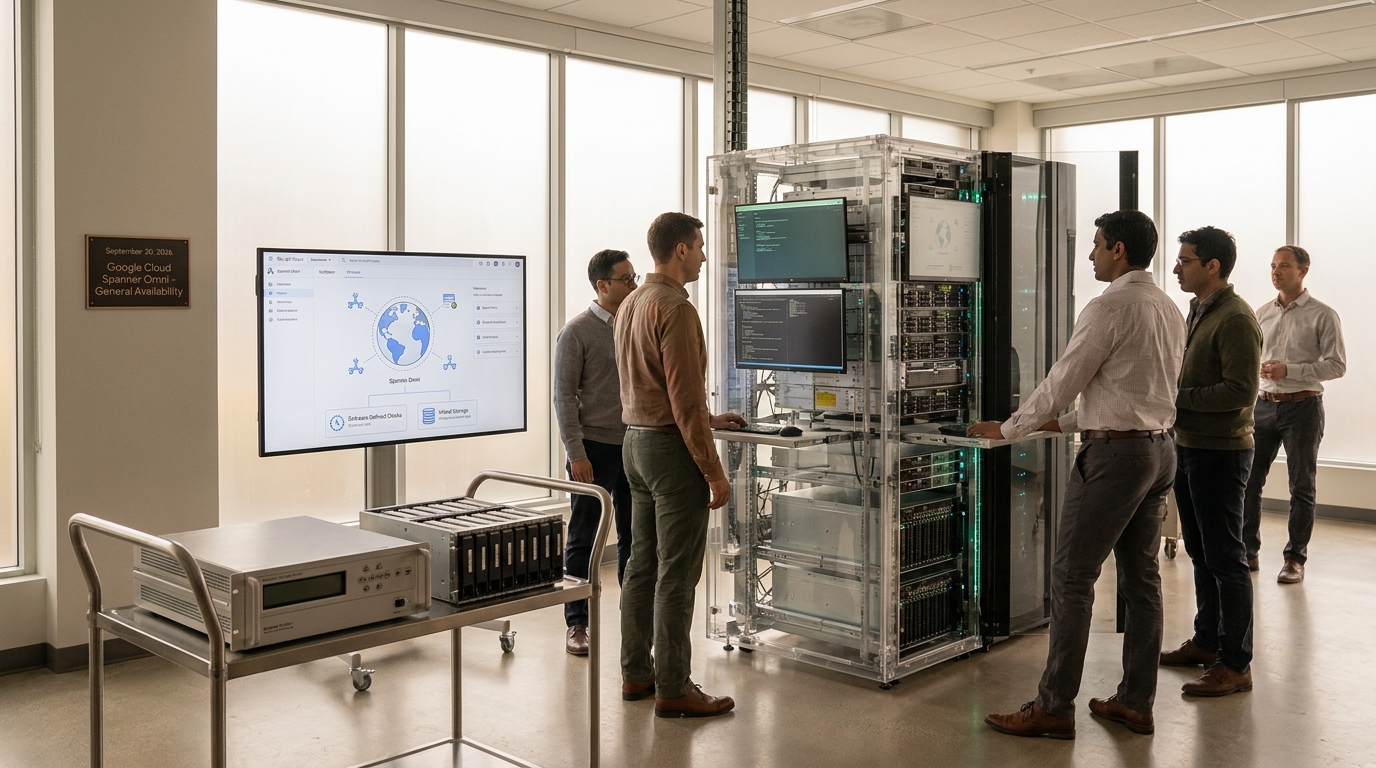

Google Cloud officially released Spanner Omni to General Availability (GA) under the 2026.r4-lts release on September 30, 2026, marking a decisive shift in how modern enterprises deploy mission-critical transactional data engines. Across its preview lifecycle earlier in the year, the software logged more than 2,000,000 downloads, reflecting intense industry interest in running Google’s flagship distributed SQL engine beyond the boundaries of Google Cloud Platform. By reaching GA, Spanner Omni delivers an unambiguous verdict to database architects: you can now deploy Google’s globally consistent, distributed relational database across your own hardware without renting a single byte of proprietary cloud infrastructure.
For more than a decade, running Spanner outside Google Cloud was technically impossible due to strict dependencies on custom datacenter hardware. Engineers designing mission-critical architectures had to accept managed service lock-in if they demanded external consistency at global scale. Spanner Omni dismantles that assumption by shifting strictly consistent distributed SQL onto commodity enterprise hardware. For teams balancing sovereign data mandates, cross-cloud resilience, and on-premises colocation against cloud vendor lock-in, this transition represents a fundamental rethinking of database portability.
The Software Shift: Retiring Physical Atomic Clocks and Colossus

The core breakthrough enabling Spanner Omni is an architectural substitution of physical datacenter infrastructure with software-level equivalents. In its native managed service inside Google Cloud, Spanner relies on Colossus, Google’s proprietary clustered file system, to manage shared disk access, replication blocks, and persistent durability. In Spanner Omni, as reported by InfoQ, engineers eliminated this dependency by replacing Colossus with an abstracted storage layer designed to sit directly on top of standard local enterprise file systems.
Even more significant is how Spanner Omni handles distributed time. Native Spanner uses TrueTime, a synchronized timekeeping mechanism reliant on chassis-mounted GPS receivers and rubidium atomic clocks installed across Google’s datacenter footprint. These physical clocks bound time uncertainty to within a few milliseconds, allowing transactions to guarantee strict serializability without complex lock negotiations across global regions. Because commodity data centers and competitor cloud platforms lack synchronized atomic clock infrastructure, Spanner Omni swaps physical hardware for a software-defined TrueTime API.
Rather than relying on specialized clock synchronization hardware, this software-defined TrueTime implementation manages transaction ordering by overlapping calculated time-uncertainty waits with concurrent operational tasks. When a write transaction commits, the node must introduce a deliberate wait interval equal to the calculated local clock uncertainty to ensure monotonic order across the cluster. In managed Google Cloud datacenters, TrueTime uncertainty bounds typically stay under a few milliseconds. On commodity servers, hypervisors, or edge environments, local Network Time Protocol (NTP) clock drift can swell that uncertainty interval significantly.
This dynamic introduces a direct performance trade-off for write-heavy transactional workloads. Because the software engine overlaps these wait states with background operations where possible, moderate workloads maintain acceptable throughput. However, workloads characterized by high write contention on shared keys will directly expose the latency penalty of software TrueTime. Database operators must recognize that eliminating Google’s physical atomic clocks trades microsecond-level commit latencies for hardware independence.
The Operational Trade-Off: Zero Google SLAs and Self-Managed Topologies
Gaining complete control over Spanner’s deployment footprint alters operational governance. When you provision managed Spanner inside Google Cloud, Google provides contractual availability Service Level Agreements (SLAs) reaching up to 99.999% uptime. With Spanner Omni, that safety net disappears entirely. Because the software runs on customer-provided machines and unmanaged networking, Google provides zero availability SLAs.
Instead of contractual guarantees, Google Cloud Documentation outlines four validated reference topologies to guide deployment resiliency:
- Single Server: A standalone node footprint suited strictly for developer testing, staging environments, and CI/CD automation pipelines.
- Single Zone: A local cluster requiring a minimum of three servers to provide local failover and raft quorum protection within a single datacenter boundary.
- Multi-Zone: A resilient enterprise footprint requiring a minimum of nine servers distributed evenly across three distinct failure domains or availability zones.
- Multi-Cluster: An advanced federated topology linking distinct Spanner Omni clusters for multi-region disaster recovery and localized data residency.
This structural change shifts the entire site reliability engineering (SRE) burden directly onto internal platform teams. Without Google managing automatic repair, hardware swaps, and network backbones, internal administrators inherit total responsibility for quorum health, disk degradation, and split-brain resolution during wide-area network partitions. In a nine-node multi-zone configuration, maintaining distributed consensus demands disciplined network provisioning to prevent partition-induced transaction rollbacks.
Infrastructure Footprint: Supported Operating Environments and the Azure Gap
Google Cloud’s official documentation defines a wide deployment matrix for Spanner Omni across containerized, bare-metal, and virtualized enterprise operating systems. Teams can install the database on bare-metal enterprise Linux distributions, run managed orchestrations through Google Kubernetes Engine (GKE), and deploy natively across Amazon Web Services environments using Amazon Elastic Kubernetes Service (EKS) and Amazon Elastic Compute Cloud (EC2) instances.
For local prototyping and administrative workflows, Spanner Omni also offers native macOS support. Providing local workstation compatibility gives development teams the ability to run functional Spanner instances directly on laptops without provisioning remote cloud development sandboxes or incurring per-hour staging costs.
However, the GA release documentation conspicuously omits support for Microsoft Azure. While AWS compute environments receive detailed configuration recipes and verified networking validation, Azure Virtual Machines and Azure Kubernetes Service (AKS) are absent from the launch matrix. For enterprise IT departments that have standardized their multi-cloud strategies around Azure infrastructure, this omission forces an architectural detour. Organizations operating primarily on Azure must either deploy Spanner Omni on customer-managed bare metal, maintain secondary AWS or GKE footprints, or manage unsupported self-built container orchestrations.
Operations, Observability, and Licensing Models
Operating a self-hosted database requires full visibility into internal process states. Native Spanner hides low-level cluster mechanics behind Google Cloud Monitoring and Cloud Logging. Spanner Omni drops this vendor-specific telemetry in favor of open standards, providing native export channels for Prometheus metrics and preconfigured Grafana visualization dashboards.
For air-gapped data centers, regulatory enclaves, and offline environments where centralized metric scrapers cannot reach, Spanner Omni includes an embedded diagnostic command-line interface. This diagnostic tool captures comprehensive thread stacks, internal transaction execution traces, and localized node log archives into an encrypted bundle, allowing internal engineering teams to debug lock contention and consensus delays without leaking data over public networks.
Commercial packaging for Spanner Omni is split into two licensing tiers designed for distinct stages of deployment:
| Licensing Tier | Pricing Model | Term / Limits | Target Use Case | Key Trade-Off |
|---|---|---|---|---|
| Developer Edition | Zero-cost ($0) | 90-day license duration | Local dev, integration testing, CI/CD validation | Time-bound expiration; non-production licensing terms |
| Commercial Edition | Per-vCPU consumption fee | Annual or multi-year enterprise agreements | Production multi-zone clusters, on-prem bare metal | Zero availability SLAs; customer assumes all SRE overhead |
Evaluating the total cost of ownership requires balancing licensing fees against infrastructure operational expenses. Managed Spanner bills compute via Spanner Processing Units (PUs) alongside storage and egress fees, baking Google’s infrastructure maintenance, automatic scaling, and 99.999% SLA into the price. Spanner Omni shifts compute billing to a per-vCPU metric, requiring teams to pay license fees alongside the raw capital costs of servers, network switches, and internal operational labor.
Multi-Model Engines, AI Agent Memory, and Enterprise Workloads
Rather than limiting Spanner Omni to simple tabular queries, Google packaged the release with full multi-model data support. Developers can execute queries using standard GoogleSQL or access the engine using PostgreSQL dialect syntax via PGAdapter. For connected relationship queries, the engine supports Spanner Graph Language natively, enabling complex graph traversals within the same relational storage engine.
To support modern machine learning pipelines, Spanner Omni incorporates built-in vector search utilizing K-Nearest Neighbor (KNN) and Approximate Nearest Neighbor (ANN) algorithms. It also includes native integration with Model Context Protocol (MCP) toolboxes, allowing distributed teams to use Spanner Omni as an external operational memory store for autonomous AI agents. By unifying tabular records, graph relationships, and high-dimensional vector embeddings within a single ACID-compliant database, organizations can eliminate the architectural complexity of synchronizing distinct databases for transactional, graph, and vector workloads.
Enterprise adoption has already moved past isolated pilot projects. Latin American e-commerce giant Mercado Libre deployed Spanner Omni across its distributed infrastructure to achieve cross-cloud hot-cold failover and maintain compliance with single-region data residency regulations. By deploying Spanner Omni directly inside target jurisdictions, their engineering teams retained Spanner’s relational consistency while keeping customer financial records strictly on local hardware.
Evaluating and Prototyping Spanner Omni
If your team is considering Spanner Omni to avoid cloud database lock-in or meet data sovereignty mandates, approach adoption systematically. Rushing a zero-SLA distributed database into production without evaluating local network stability introduces severe operational risks. Use the following structured evaluation sequence to test Spanner Omni:
- Step 1: Deploy the Developer Edition locally. Download the zero-cost Developer Edition on macOS or a Linux workstation. Verify that your core schemas and SQL queries execute correctly across either the GoogleSQL dialect or PGAdapter without needing schema refactoring.
- Step 2: Benchmark write latency against your existing database. Deploy a 3-node single-zone test cluster on commodity hardware. Run your production write profiles against the cluster to accurately measure the commit latency overhead introduced by software TrueTime time-uncertainty wait states compared to local PostgreSQL or MySQL instances.
- Step 3: Audit cluster architecture against the 9-node multi-zone standard. Before designing a multi-zone production deployment, confirm your platform engineering budget can support at least nine dedicated nodes spread across three distinct failure zones. Factor in redundant network switches and low-jitter local links to prevent consensus drops.
Prior to rolling out production nodes, audit your site reliability engineering team’s readiness. Your staff must have established procedures for replacing failed server disks, maintaining Prometheus alert pipelines, handling raft consensus degradation, and performing node-level diagnostic collections using the embedded CLI.
The New Baseline for Portable Distributed SQL
Spanner Omni proves that globally consistent distributed SQL can thrive without specialized atomic clocks, proprietary file systems, and vendor-locked datacenter infrastructure. For organizations running large-scale footprints across AWS, bare metal, and hybrid enclaves, it offers true relational scalability paired with total infrastructure independence.
Yet this autonomy comes with clear boundaries. If your operational team is small or lacks distributed systems expertise, forfeiting Google’s 99.999% availability SLA and absorbing the operational overhead of a 9-node multi-zone cluster may cost more in operational strain than it saves in portability. Spanner Omni is an enterprise-grade database built for organizations that possess mature internal operations and require absolute control over where their data lives.
Frequently Asked Questions
How does Spanner Omni replace physical atomic clocks?
Spanner Omni uses a software-defined TrueTime API that ensures monotonic transaction ordering by overlapping calculated clock-uncertainty wait times with operational tasks, replacing native GPS and rubidium atomic clock hardware.
Does Spanner Omni include Google availability SLAs?
No, Google provides zero availability SLAs for Spanner Omni because it runs entirely on customer-managed hardware, networking, and hypervisors.
Which operating environments support Spanner Omni?
Spanner Omni supports bare-metal enterprise Linux, Google Kubernetes Engine (GKE), AWS (via EKS and EC2), and macOS for local prototyping, but GA documentation omits Microsoft Azure.
How is Spanner Omni licensed?
It offers a zero-cost 90-day Developer Edition for testing and a Commercial Edition billed per vCPU through annual or multi-year enterprise agreements.
Sources
- helpnetsecurity.com — October 2026 Patch Tuesday forecast: Time for an Office cleanup
- github.blog — GitHub Copilot in VS Code, September 2026 releases
- infoq.com — Spanner Omni Reaches GA, Replacing Google’s Atomic Clocks and File System with Software
- cloud.google.com — Google Cloud Blog
- docs.cloud.google.com — Google Cloud Documentation