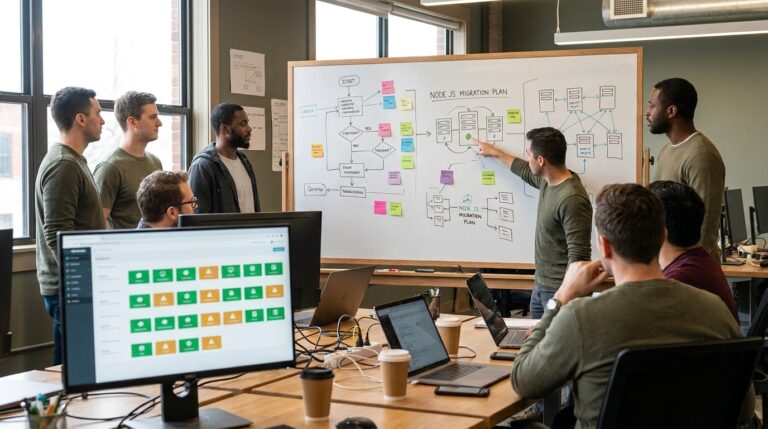


The landscape of software development is undergoing a seismic shift, driven by the rapid evolution of artificial intelligence. According to a recent report by India Today (indiatoday.in), Ryan Dahl, the visionary creator of Node.js and Deno, has signaled a definitive end to the traditional era of humans writing code manually [1]. This assertion from one of the most influential figures in the JavaScript ecosystem highlights a transition that is no longer theoretical but actively reshaping the global technology sector.
As AI-powered tools become more sophisticated, the role of the software engineer is moving away from the “keyboard-heavy” task of syntax management toward higher-level system orchestration. This transition is not merely about speed; it represents a fundamental change in how humans interact with machines to solve complex problems. The India Today coverage suggests that while the “writing” of code may be fading, the “engineering” of software is entering a new, more efficient phase [1].
The Ryan Dahl Perspective: A Shift in Software Philosophy
Ryan Dahl’s contributions to the tech world, particularly the creation of Node.js, revolutionized how servers are built, enabling scalable, event-driven architectures. When a figure of his stature suggests that the era of humans writing code is over, the industry listens. Dahl’s perspective, as detailed by India Today, is that the next generation of software professionals will need to pivot their focus toward “prompt engineering” and “model training” [1].
This shift implies that the primary bottleneck in software development—the manual translation of human logic into machine-readable syntax—is being solved by Large Language Models (LLMs). Instead of spending hours debugging a specific loop or configuring a boilerplate environment, engineers are now expected to guide AI systems to perform these tasks. The “next options” for engineers, according to Dahl, involve mastering the interfaces that control these models rather than the languages they output [1].
The Move Toward Prompt Engineering
Prompt engineering has emerged as a critical discipline in this new era. It is defined as the strategic art and science of designing and optimizing inputs to guide AI models, particularly LLMs, toward generating a specific, desired response [4]. In the context of software development, this means a developer must be able to describe complex system requirements in a way that an AI can translate into functional, secure, and efficient code.
Rather than being a “soft skill,” prompt engineering is increasingly viewed as a foundational technical competency. It acts as the primary interface for leveraging the power of LLMs, requiring a deep understanding of both the problem domain and the underlying behavior of the AI model [1].
How AI Code Assistants are Redefining Productivity
The integration of AI into the development lifecycle is already yielding measurable results. Reports indicate that AI tools are currently increasing developer productivity by a significant margin of 10% to 30% [1]. This boost is not just about writing code faster; it is about the comprehensive improvement of the development process.
Faster Coding and Reduced Errors
AI code assistants, such as GitHub Copilot or similar LLM-based tools, change the development process by enabling rapid prototyping. These tools can suggest entire blocks of code based on a few comments, drastically reducing the time spent on repetitive or “boilerplate” tasks. Furthermore, by analyzing vast datasets of existing code, these AI systems can identify common patterns and potential bugs before they are even committed, leading to improved code quality and fewer runtime errors [1].
Automation of Repetitive Tasks
One of the most immediate benefits of AI in the workplace is the automation of mundane, repetitive tasks. This includes writing unit tests, generating documentation, and refactoring legacy code. By offloading these chores to AI, human developers are freed to focus on the creative aspects of software design, such as user experience (UX) and the development of personalized features that differentiate a product in a crowded market [1].
The Evolution of the Software Engineering Career Path
With the rise of AI, many professionals fear for their job security. However, the India Today report offers a more nuanced view of the labor market. The emergence of AI does not necessarily mean the end of the IT professional; rather, it changes which professionals remain valuable [1].
The Resilience of Senior Professionals
AI is not currently positioned to replace senior IT professionals who possess a blend of technical expertise and “human” skills. Those who are capable of leading teams, communicating complex ideas to stakeholders, and making high-level architectural decisions remain indispensable. The report suggests that AI is more likely to replace “invisible” or “poorly positioned” workers—those whose roles are limited to routine, low-level tasks that require little strategic thinking or communication [1].
A Complementary Relationship
The relationship between traditional coding and prompt engineering is increasingly seen as complementary rather than competitive. Traditional coding provides the deterministic, structural backbone of a system—the “rails” on which a program runs. Prompt engineering, meanwhile, orchestrates the intelligence within those systems, allowing for dynamic, AI-driven features that would be too complex to hard-code manually [1].
Prompt Engineering as a Foundational Skill
As the industry moves forward, prompt engineering is being recognized as a new foundational skill for a vast class of problems. It is no longer just a trick for getting better results from a chatbot; it is a rigorous method for interacting with the most powerful computational tools ever created.
Designing the Primary Interface
For many modern software problems, the primary interface is no longer a compiler or a text editor, but the prompt itself. This requires a shift in mindset:
- From Syntax to Logic: Engineers must focus more on the “what” and “why” rather than the “how” of syntax.
- Iterative Refinement: Developing software now involves an iterative process of refining prompts to narrow down the AI’s output to the perfect solution.
- Model Awareness: Understanding the nuances of different models (e.g., GPT-4 vs. Claude vs. specialized coding models) becomes as important as knowing the difference between C++ and Python.
The Strategic Implications for the Tech Industry
The transition described by Ryan Dahl and reported by India Today has broad implications for how companies hire, train, and build products. If productivity increases by 30% across the board, the speed of innovation will accelerate, but the barrier to entry for creating software will also lower [1].
Economic and Competitive Advantages
Companies that successfully integrate AI into their workflows will have a massive competitive advantage. They will be able to bring products to market faster and with fewer resources. However, this also means that the “moat” created by having a large team of junior developers is evaporating. The value is shifting toward unique data, proprietary model training, and the ability to solve problems that AI cannot yet grasp—such as complex business logic and human-centric design.
The Role of Model Training
Beyond prompt engineering, Dahl suggests that “model training” will be a key area for future engineers [1]. This involves fine-tuning existing models on specific datasets to make them more accurate for particular industries, such as healthcare, finance, or legal tech. Engineers who can bridge the gap between raw data and a fine-tuned, production-ready AI model will be in high demand.
Conclusion: Adapting to the New Reality
The era of humans writing every line of code may be drawing to a close, as suggested by Ryan Dahl in the India Today report, but the era of the software architect is just beginning [1]. The shift from manual coding to AI-assisted orchestration represents a maturation of the industry. It allows developers to move away from the “mechanics” of programming and toward the “soul” of software: solving human problems and creating value.
For current and aspiring software engineers, the message is clear: the future belongs to those who can master the new tools of the trade. By embracing prompt engineering, model training, and the leadership skills that AI cannot replicate, professionals can ensure they remain at the forefront of the technological revolution. The code may be generated by a machine, but the vision, the direction, and the ultimate purpose of the software remain firmly in human hands.