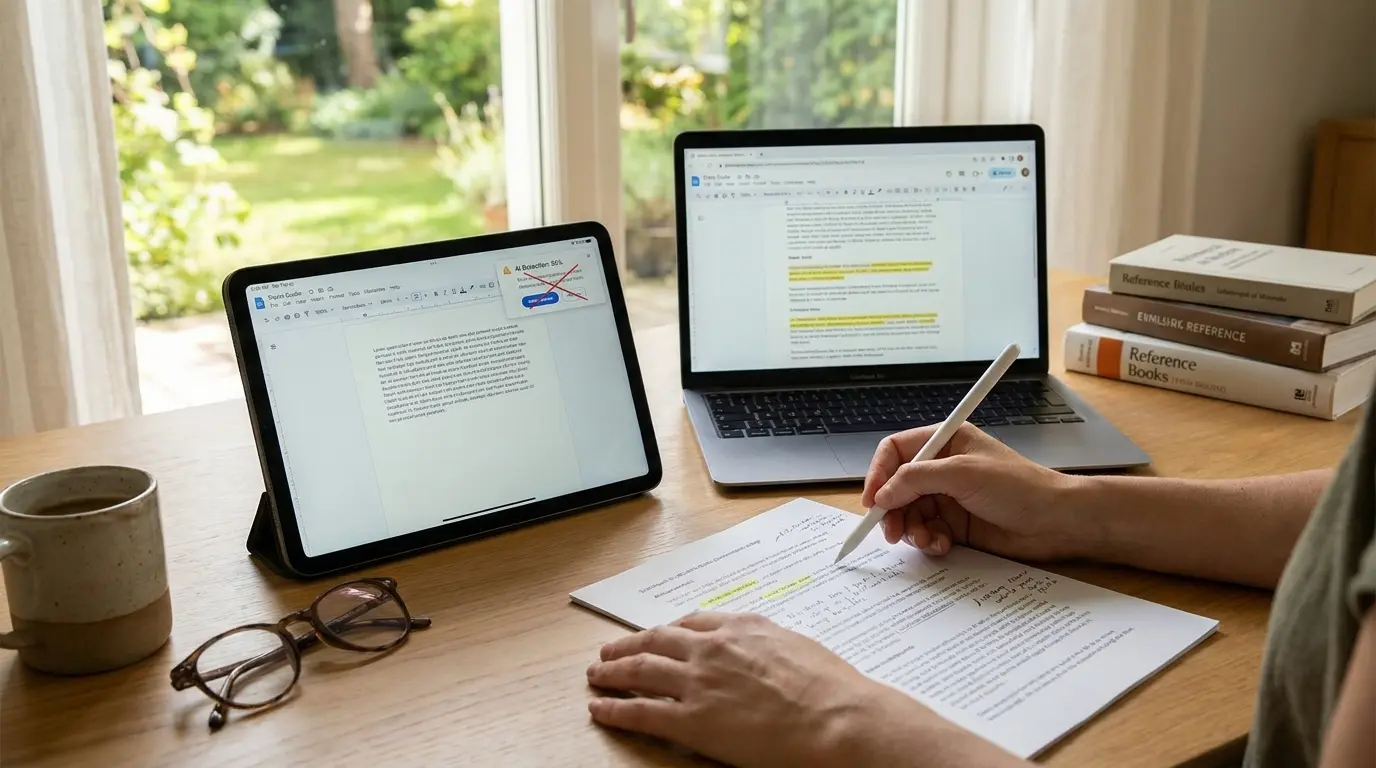

If you use an AI writing tool to draft content for your business, you have likely run into an annoying hurdle: automated AI detectors. Getting falsely accused of submitting robotic prose hurts your professional reputation. In this guide, you will learn systematic editing techniques to neutralize the linguistic patterns that trigger automated detection tools, without ruining the quality of your prose.
Scrutiny over AI content has climbed rapidly across every industry. As publishing expert Jane Friedman points out, literary agents, publishers, and corporate clients now systematically scan submissions before they even read them. This intense gatekeeping happened for a reason. Editors at magazines like Clarkesworld saw monthly submissions double from 1,100 in 2021 to over 2,200 by February 2023, eventually forcing them to temporarily close their portal and manage a 30% jump in workload. To protect your work from automated filters, you only need an AI-assisted draft, a standard word processor, and access to a testing classifier.
What You Need Before Starting
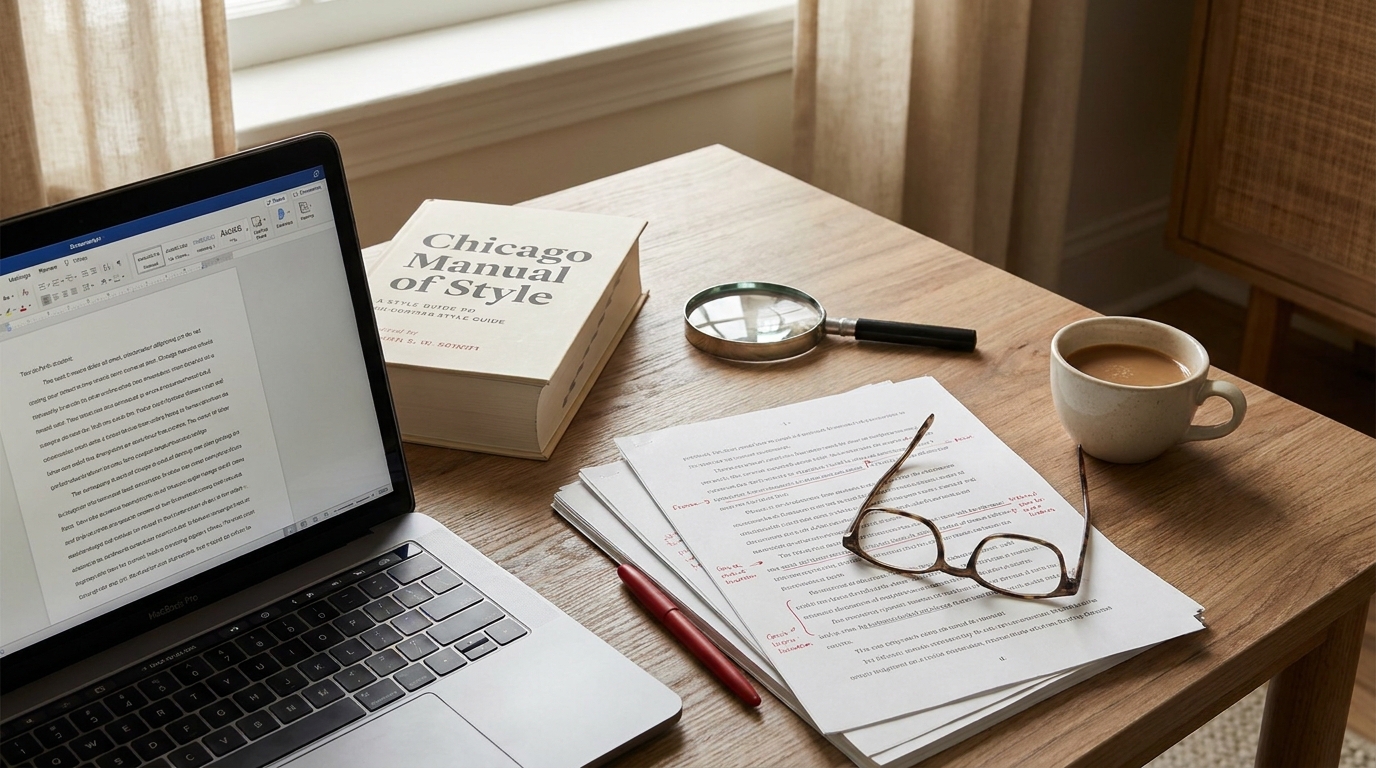
Before editing, assemble a focused workspace. Do not proofread in your primary client deliverable. Instead, build a separate testing document to isolate draft versions from final copies.
| Tool Type | Recommended Setup | Primary Purpose | Key Limitation |
|---|---|---|---|
| Document Editor | Google Docs or Microsoft Word | Track live revisions and search syntax | Does not detect AI tokens natively |
| Detection Classifier | Pangram or similar tool | Pre-submission baseline scanning | High rate of false positives on clean human text |
| Plain Text Scrubber | Notepad or clipboard cleaner | Strip hidden rich-text formatting tags | Removes bolding and inline links |
Isolating your draft in a staging sandbox prevents accidental overwrites. It also gives you a clean baseline document to run through diagnostic scanners.
Phase 1: Neutralize AI Vocabulary and Phrasing Patterns
Automated classifiers look at language through statistical math rather than reading comprehension. Large language models favor specific words and symmetrical sentence structures at rates vastly higher than human authors. According to data compiled by detector platform Pangram, machine text repeatedly uses certain lexical markers that scream robotic generation. Your first job is to scrub these telltale terms.
Step 1: Purge High-Frequency Machine Buzzwords
Open the Find and Replace tool in your word processor. Search your document for high-frequency vocabulary outliers like “delve,” “tapestry,” and “beacon.”
Machine algorithms deploy these terms at rates human writers rarely match. Pangram’s internal tallies show that AI models use the word “delve” roughly 30 times per 10,000 words. In contrast, human writers use it only 3 times per 10,000 words. That ten-to-one ratio instantly spikes classifier risk scores.
Swap every instance of “delve” with direct verbs. Try words like “examine,” “dig into,” “study,” or “analyze.” Replace figurative clichés like “tapestry” or “testament” with plain, grounded nouns. Simple language keeps the reader engaged and lowers your machine-probability score.
Step 2: Dismantle Antithetical Framing Structures
Search your draft for correlative conjunctions and balanced contrasting phrases. Look specifically for constructions like “not only… but also” or “not just X, but Y.”
Language models love these formulas to sound balanced and authoritative. Pangram reports that AI output features “not just X, but Y” constructions three times more often than human writing. Classifiers treat this repeated symmetry as a major red flag.
Break these balanced clauses into asymmetric, declarative sentences. For example, instead of writing, “This strategy is not just affordable, but remarkably effective,” try a punchier option: “This strategy saves money. It also delivers solid results.” By ditching parallel clauses, you disrupt the mathematical predictability detectors look for.
Phase 2: Restructure Cadence, Syntax, and Punctuation
Classifiers rely heavily on punctuation density and phrase length. Because these tools are brittle, tiny typographical tweaks can drastically shift their verdicts. In fact, tests on Pangram revealed that swapping a single em dash for a colon can flip a document’s classification from 100% AI straight to 100% human. Refining your punctuation creates natural rhythmic variety.
Step 3: Slash Excessive Em Dash Usage
Count every em dash in your article and cut them aggressively. Aim for no more than one em dash per two thousand words.
Language models lean heavily on em dashes to stitch clauses together. Pangram’s data shows AI text contains 17 em dashes per 10,000 words, compared to only 2 in human writing. As Bloomberg’s Morgan Meaker reported, this disparity is so noticeable that researchers have actively pushed labs to train models away from using the mark.
Replace surplus em dashes with colons, parentheses, commas, or full stops. Splitting long, dash-heavy sentences into two shorter thoughts immediately resets the cadence. It also cuts a major marker that detection algorithms track.
Step 4: Disrupt the Formulaic “Rule of Three” Structure
Scan your draft for any list containing exactly three items. This includes three adjectives describing a noun, three parallel verbs, or three snappy bullet points.
Generative models default to triplets to create tidy cadence. Pangram records that machine text employs the rule of three 19 times per 10,000 words, while human writing uses it only 5 times. When every paragraph features a three-part list, classifiers detect low perplexity and score the passage as synthetic.
Prune your triplets down to two strong points, or expand them into four descriptive elements. Mix up your sentence lengths around these lists. Follow a quick five-word sentence with a longer twenty-word explanation. This intentional variety creates the irregular rhythm typical of human thought.
Phase 3: Verify Drafts and Document Human Provenance
Even skilled writers get caught in automated crosshairs. A study published in the International Journal for Educational Integrity tested four leading detectors across 160 academic papers. Pangram correctly flagged AI use in 37 of 40 mixed papers, and 37 of 40 papers where humans manually rewrote machine text. That sensitivity poses real risks for innocent creators. Ghostwriter Sally McGraw faced client rejection after multiple tools flagged her work, showing how essential verifiable records are.
Step 5: Run Pre-Flight Scans Across Commercial Classifiers
Copy your edited draft and run it through a detector like Pangram before delivering it to an editor or publishing it online.
Publishers and enterprise clients now use these scanners to filter submissions before opening attachments. Jane Friedman notes that publishers rely on tools like Pangram because they cannot take authors on blind trust alone at commercial scale.
Never treat a detection score as an absolute moral verdict. Use the tool’s visual output as a heatmap. Look for remaining clusters of highlighted sentences. If the tool flags a specific paragraph, do not panic. Simply rewrite that section with shorter clauses and different vocabulary until the cluster clears.
Step 6: Maintain Version History and Keystroke Provenance
Draft and edit exclusively in a cloud word processor that keeps an immutable version history, such as Google Docs.
False positives happen unexpectedly. Sally McGraw received an email from a prospective client stating that multiple AI detectors had flagged her book proposal sample. Although the client paid McGraw and cited fit rather than the detector as the hiring factor, McGraw believes the flag cost her the contract. When clients question your authorship, you need proof of human labor.
Export your revision log before submitting your work. A document history showing timestamps, manual revisions, cut passages, and incremental typing proves human authorship. This audit trail gives you defensible evidence that no statistical classifier score can overturn.
Common Mistakes to Avoid
Writers often panic after a false flag and adopt editing tricks that do more harm than good. Avoid these three common traps:
- Intentionally seeding typos: Bloomberg’s Morgan Meaker reported that some writers now insert typos to fool classifiers. This is a bad idea. Typos ruin your professional reputation with human readers, and modern detector updates look right past deliberate spelling mistakes.
- Relying on AI rewrite prompts: Asking another AI model to “rewrite this so it sounds human” rarely works. In the June study from the International Journal for Educational Integrity, detectors still caught 37 out of 40 papers that combined human and machine text, including rewritten drafts. Automated spinning preserves the underlying mathematical structure that detectors evaluate.
- Assuming natural human prose is safe: You might think your organic writing style is safe from false flags. It is not. Science writer Janelle Shane ran her own original work through Pangram and saw it flagged as AI with 98.7% confidence. Clean, grammatically balanced human writing regularly matches the statistical profile of machine output.
Expected Results and Verdict
Once you finish this proofreading process, your draft will have varied sentence lengths, natural punctuation, and grounded vocabulary. Most importantly, it will lack the statistical fingerprints that trigger automated filters. You will protect your client relationships while submitting clean, readable prose.
This systematic proofreading workflow is ideal for freelance writers, ghostwriters, and small marketing teams who use AI for research and drafting. If you write raw fiction or personal essays, skip heavy classifier tracking and rely instead on your personal voice and revision history. Jane Friedman observes that while the AI detection craze will likely have a short shelf life as industry practices mature, screening tools remain common right now. Taking control of your manual editing protects your business while the publishing world sorts out its standards.
Frequently Asked Questions
Why does AI-assisted writing get flagged by automated detection tools?
Automated detectors look for mathematical predictability, such as repetitive buzzwords, symmetrical sentence structures, and consistent phrase lengths that machine models favor over human prose.
Can pure human writing be falsely flagged as AI content?
Yes. Clean, grammatically balanced human writing frequently mirrors machine statistical patterns, leading detectors to assign high synthetic probability scores to completely human drafts.
How can writers prove their content is human if it gets flagged?
Writers should draft and edit in cloud documents that record immutable version histories and keystrokes, providing an audit trail of manual revisions that statistical classifiers cannot dispute.