
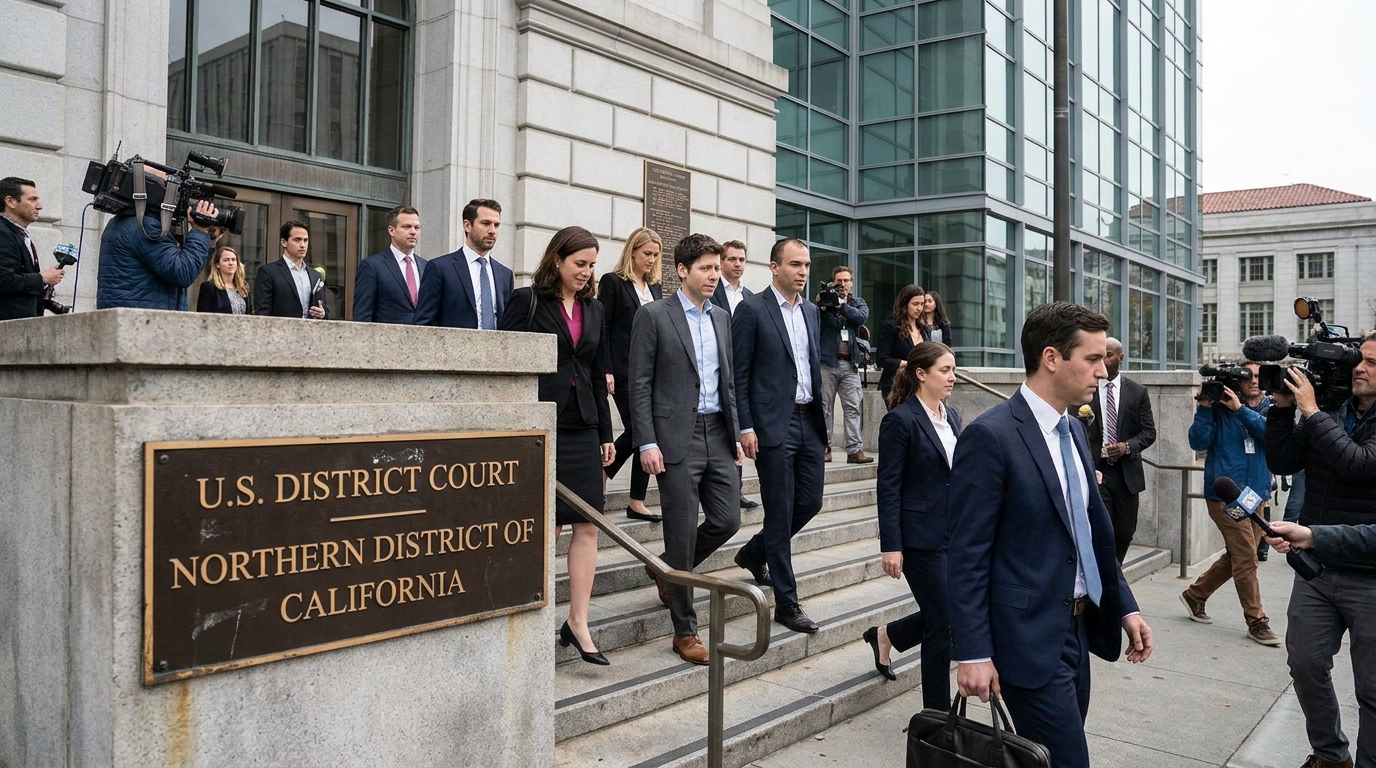

A federal jury in Oakland has cleared Sam Altman, Greg Brockman, and OpenAI of all claims in a landmark Elon Musk lawsuit that alleged the company abandoned its founding mission. The verdict was delivered following an 11-day trial, with jurors reaching a unanimous decision after less than two hours of deliberation. Immediately following the advisory verdict, Judge Yvonne Gonzalez Rogers dismissed the remaining claims, bringing a swift conclusion to one of the most high-profile legal battles in the technology sector.
The speed of the jury’s decision suggests a significant disconnect between Musk’s allegations and the legal evidence presented in court. While the trial spanned nearly two weeks and featured testimony from the most powerful figures in Silicon Valley, the jury required very little time to find the defendants not liable. This rapid resolution indicates that the plaintiff’s arguments failed to gain traction despite the complex nature of the claims regarding corporate governance and non-profit obligations.
This ruling serves as a pivotal moment for OpenAI as the company reportedly prepares for a 2026 initial public offering (IPO). By removing a massive legal hurdle and clearing its top leadership of liability, the company has secured its path toward a transition that could redefine its corporate structure. The case represented a fundamental conflict between Musk’s vision of a permanently non-profit entity and OpenAI’s defense that an evolution toward a for-profit model was a necessary step for the safe development of Artificial General Intelligence (AGI).
The proceedings were widely viewed as a landmark test for the AI industry, touching on how non-profit foundations can transition into multi-billion-dollar commercial enterprises. For Silicon Valley, the verdict provides a degree of legal clarity regarding the flexibility of mission statements and the binding nature of early informal agreements. The outcome shifts the focus from OpenAI’s past organizational changes to its future as a dominant commercial player in the global technology market.
Rapid Jury Deliberation and the Procedural Dismissal
The jury specifically found that Sam Altman, Greg Brockman, and OpenAI were not liable for breach of contract or unjust enrichment. These specific counts were the core of Musk’s attempt to prove that the defendants had profited unfairly from technology that was originally intended to be open-source and non-commercial. By rejecting these claims, the jury signaled that the evidence did not support the existence of a legally binding “founding agreement” that Musk claimed had been violated.
The trial in Oakland featured high-stakes testimony from Microsoft CEO Satya Nadella, Sam Altman, and Musk himself. Jurors were tasked with weighing internal communications against the formal legal obligations of the parties involved. The fact that the jury returned a verdict in under two hours suggests that the defense’s narrative—portraying the lawsuit as a strategic move by a competitor—was more persuasive than Musk’s claims of a “stolen” mission.
Judge Yvonne Gonzalez Rogers acted immediately following the jury’s advisory verdict to dismiss Musk’s claims on the spot. This procedural finality prevented the case from lingering in the district court and provided OpenAI with an immediate legal victory. The courtroom atmosphere during the announcement was described as a definitive conclusion to months of legal posturing between the former partners.
The speed of the verdict also reflects on the perceived strength of the evidence Musk brought to the trial. In complex corporate litigation, deliberations often last days; a two-hour window generally indicates that the jury found the plaintiff failed to meet the burden of proof on the most basic elements of the case. This outcome effectively validates OpenAI’s current operational trajectory and the leadership of Altman and Brockman.
The Decisive Role of the Statute of Limitations
A primary factor in Musk’s defeat was the determination that the lawsuit was filed outside the applicable statute of limitations. According to court records, several of the counts faced specific legal deadlines of August 5, 2021, and November 14, 2021. Because Musk did not file his complaint until 2024, the court found that many of the events he sought to litigate were already beyond the window for legal recovery.
The defense highlighted that the events Musk cited as evidence of a breach occurred years before he took legal action. This contrast between the historical evidence and the 2024 filing date allowed the jury to prioritize the legal timeline over the substantive arguments regarding the “founding mission.” In high-stakes corporate litigation, such procedural technicalities frequently outweigh the emotional or philosophical arguments presented by plaintiffs.
Legal reasoning for this prioritization stems from the principle that parties cannot wait indefinitely to bring claims after a perceived harm has occurred. By failing to act when OpenAI first began its transition to a capped-profit model in 2019, Musk significantly weakened his legal standing. The jury’s focus on these timelines underscores the importance of prompt legal action in disputes involving evolving corporate structures.
This procedural focus also shielded the jury from having to make a definitive moral judgment on whether OpenAI’s shift was “right” or “wrong” in a social sense. Instead, the verdict rested on whether Musk had the right to sue at this late stage. The result demonstrates that even in cases involving transformative technology like AGI, standard civil procedure remains the ultimate arbiter of liability.
Financial Stakes and the Path to a $1 Trillion IPO
The financial implications of the verdict are substantial, as Musk had demanded the redistribution of $134 billion to $150 billion from OpenAI’s for-profit arm back to its non-profit side. Such a redistribution would have effectively dismantled the company’s current commercial operations and its relationship with major investors. With the jury clearing the defendants, OpenAI retains control over its massive capital reserves and intellectual property.
OpenAI is currently valued at approximately $852 billion, according to reports from Fox Business. The removal of this legal cloud is expected to stabilize investor confidence as the company looks toward a planned 2026 IPO. Industry analysts suggest that the company is targeting a valuation of trillion or more, a milestone that would have been nearly impossible to achieve with an active lawsuit threatening its core financial structure.
The verdict also protects the interests of OpenAI’s employees and early investors who hold equity in the for-profit entity. A ruling in Musk’s favor could have led to a forced restructuring that would have wiped out significant personal wealth. Now, the company can proceed with its financial roadmap without the threat of a court-ordered asset redistribution.
Investor confidence is further bolstered by the jury’s rejection of the “unjust enrichment” claim. This finding suggests that the profits generated by OpenAI are legally legitimate and not the result of deceptive practices or broken promises to early donors. This legal validation is critical for a company seeking to attract the massive amounts of capital required for future AI compute and infrastructure needs.
Corporate Reactions and the Ninth Circuit Appeal
Following the verdict, OpenAI’s lead attorney Bill Savitt described the lawsuit as a “hypocritical attempt to sabotage a competitor.” This statement reflects OpenAI’s long-standing defense that Musk’s legal actions were motivated by his own interests in the AI space. Microsoft, which was cleared of claims that it aided and abetted a breach of contract, welcomed the verdict and reaffirmed its ongoing partnership with OpenAI.
Elon Musk addressed the ruling on X, the social media platform he owns, by framing the procedural defeat as a “moral victory.” He argued that the trial exposed what he called the “looting” of non-profits, which he believes sets a dangerous precedent for charitable giving in the United States. Musk announced that he would appeal the decision to the Ninth Circuit Court of Appeals to continue the challenge.
The likelihood of success for an appeal based on procedural grounds is generally considered lower than appeals based on substantive legal errors. Because the jury found the defendants not liable on the facts and the judge dismissed the case based on the statute of limitations, Musk faces a difficult path in overturning the result. The Ninth Circuit will likely focus on whether Judge Rogers applied the statute of limitations correctly rather than re-evaluating the mission of OpenAI.
Microsoft’s reaction highlights the relief felt by OpenAI’s largest financial backer. As reported by The Guardian, the tech giant’s partnership with OpenAI is a cornerstone of its current growth strategy. Clearing Microsoft of liability ensures that the multi-billion-dollar collaboration can continue without the risk of court-ordered interference or damages.
Trial Disclosures: Internal Emails and the Cost of Discovery
While OpenAI emerged victorious, the trial resulted in the public release of sensitive internal emails, diary entries, and text messages from prominent Silicon Valley figures. This “cost” of victory means that previously private discussions about the company’s internal power struggles and financial motivations are now part of the public record. Trending Topics reported that these disclosures provided a rare look into the personal ambitions behind the world’s leading AI lab.
One notable disclosure involved a 2017 diary entry by Greg Brockman, in which he weighed his personal financial ambitions against the broader goal of benefiting humanity. On the witness stand, Brockman testified that his personal stake in OpenAI is currently valued at approximately $30 billion. These revelations highlight the immense personal wealth generated by the company’s shift away from its original non-profit-only model.
The release of these documents carries reputational risks for the company’s leadership. The internal communications often showed a more pragmatic, business-oriented approach than the public-facing mission of “benefiting all of humanity” might suggest. For some observers, this “Silicon Valley laundry” being aired in court confirms that the transition to a for-profit model was driven by both necessity and the desire for commercial success.
However, the jury’s decision indicates that these internal reflections did not equate to a legal breach. While the documents may be used by critics to question the company’s ethics, they did not provide the “smoking gun” needed to prove a breach of contract. The discovery process has concluded, and while the emails remain public, their legal utility for Musk has been exhausted in the district court.
Historical Context: The 2015 Founding and the Power Struggle
The origins of the dispute date back to OpenAI’s founding in 2015 as a non-profit dedicated to developing AI for the benefit of humanity. Musk was a key early supporter, contributing approximately $38 million to the initiative. He argued that the subsequent creation of a for-profit arm and the multi-billion-dollar deal with Microsoft were direct violations of the principles he funded.
OpenAI’s defense countered this narrative by highlighting Musk’s own actions before his departure from the board in 2018. According to Fox Business, the company noted that Musk himself had pursued a merger between OpenAI and Tesla. They also presented evidence that Musk was involved in discussions about creating a for-profit entity long before the current structure was finalized, suggesting his objections were based on a loss of control rather than a change in mission.
The company further argued that Musk’s lawsuit was a tactical move to benefit his own AI startup, xAI. By attempting to force OpenAI back into a non-profit structure, Musk would have effectively crippled his primary competitor. The jury’s verdict suggests they accepted the argument that OpenAI’s evolution was a legitimate response to the rising costs of AI development rather than a deceptive scheme.
This historical context illustrates the deep-seated rivalry between Musk and the leadership he helped install. The transition from 2015’s idealistic mission to 2026’s commercial powerhouse reflects the broader shift in the AI industry toward massive scale and capital intensity. The legal system has now weighed in, siding with the necessity of that evolution over the strict adherence to original non-profit structures.
The conclusion of this trial reinforces the current leadership stability at OpenAI. Following a failed attempt by a previous board to remove Altman and Brockman in late 2023, this legal victory further solidifies their positions. As the Ninth Circuit appeal looms, the company moves forward with its commercial and technical roadmap, having successfully defended its transition from a small research lab to a global technology leader.